

Frozen Shoulder (Adhesive Capsulitis): Detailed Overview
What Is Frozen Shoulder?
Frozen shoulder, medically called adhesive capsulitis, is a painful condition where the connective tissue capsule surrounding the shoulder joint becomes inflamed, thickened, and contracted, causing progressive loss of shoulder movement.
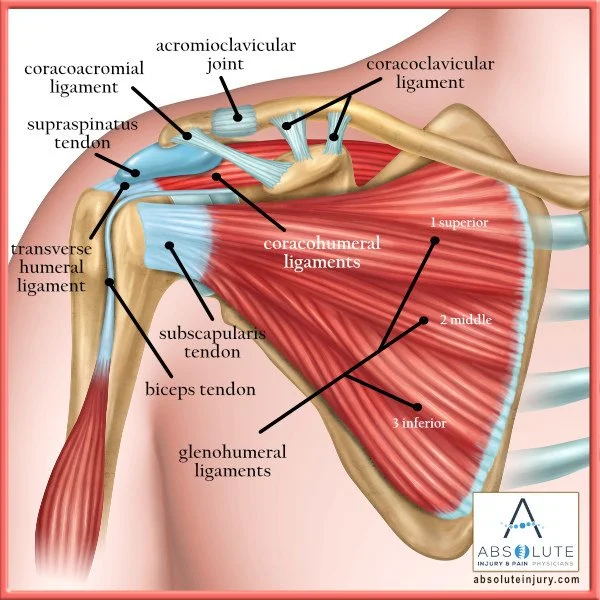
The shoulder is a ball-and-socket joint (the glenohumeral joint) surrounded by a flexible capsule that allows a very large range of motion. In frozen shoulder, this capsule becomes:
Inflamed
Thickened
Fibrotic (scar-like)
Tightened around the joint
As the capsule shrinks, the shoulder has less room to move, creating stiffness and pain.
A hallmark feature of frozen shoulder is that both active and passive range of motion are restricted:
Active movement: The person cannot move the shoulder fully themselves.
Passive movement: Even when someone else moves the arm, the motion is still limited.
This distinguishes frozen shoulder from many muscle or tendon injuries where passive motion is often preserved.
Who Develops Frozen Shoulder?
Frozen shoulder affects about 2–5% of the population and is most common in:
Adults between 40–60 years old
Women slightly more often than men
People with diabetes or metabolic conditions
Risk factors include:
Medical Conditions
Diabetes (especially poorly controlled blood sugar)
Thyroid disorders
Parkinson’s disease
Cardiovascular disease
Autoimmune conditions
Injury or Immobilization
Frozen shoulder can develop after:
Shoulder surgery
Rotator cuff injury
Fracture
Stroke
Long periods of keeping the arm still
Other Risk Factors
Previous frozen shoulder in the opposite shoulder
Hormonal changes (such as menopause)
Certain inflammatory conditions
Symptoms of Frozen Shoulder
Symptoms usually develop gradually and progress through stages.
Common symptoms include:
Pain
Deep aching pain in the shoulder
Pain often worse at night
Difficulty sleeping on the affected side
Pain with reaching movements
Common painful activities:
Putting on a jacket
Reaching behind the back
Brushing hair
Fastening a bra
Reaching overhead
Putting dishes away
Stiffness
Loss of motion is usually progressive.
Typical limitations:
Difficulty lifting the arm overhead
Difficulty rotating the arm outward
Difficulty reaching behind the back
The most restricted movement is often:
External rotation (turning the arm outward)
The Three Stages of Frozen Shoulder
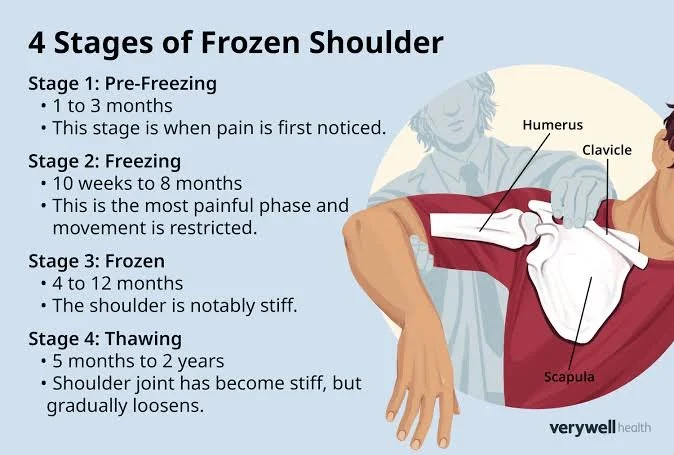
Frozen shoulder typically follows three phases. The entire process can take 1–3 years, although recovery varies.
Stage 1: Freezing Stage (Painful Stage)
Duration:
Approximately 2–9 months
This is when inflammation is increasing.
Symptoms:
Gradually worsening shoulder pain
Increasing stiffness
Pain often severe at night
Sleep disruption
Increasing difficulty using the arm
Movement becomes more limited as pain causes protective guarding.
Examples:
Reaching overhead becomes painful
Putting on clothing becomes difficult
Rotating the arm outward becomes restricted
What is happening biologically?
The shoulder capsule becomes inflamed and begins forming adhesions (scar-like restrictions).
Treatment during this stage focuses on:
Controlling inflammation
Maintaining safe movement
Preventing excessive stiffness
Aggressive stretching during this stage can sometimes worsen pain because the tissues are highly irritated.
Stage 2: Frozen Stage (Stiffness Stage)
Duration:
Approximately 4–12 months
Pain may decrease, but stiffness becomes the dominant problem.
Symptoms:
Significant loss of shoulder motion
Difficulty with daily activities
Shoulder feels “stuck”
Less sharp pain but persistent tightness
People often describe:
“My shoulder feels locked.”
“I can’t get my arm into certain positions.”
“It stops like there is a mechanical block.”
The capsule has contracted significantly.
Treatment focuses on:
Restoring mobility
Gentle stretching
Joint mobilization
Functional movement
Stage 3: Thawing Stage (Recovery Stage)
Duration:
Approximately 6 months–2 years
Movement gradually returns.
Symptoms:
Less pain
Increased range of motion
Improved function
The shoulder capsule slowly remodels and becomes more flexible.
Recovery is usually gradual rather than sudden.
Diagnosis of Frozen Shoulder
Diagnosis is primarily clinical.
A healthcare provider evaluates:
1. Medical History
Questions include:
When did symptoms start?
Was there an injury?
Is pain worse at night?
What movements are limited?
Are there diabetes or thyroid issues?
2. Physical Examination
The provider checks:
Range of Motion
Typical frozen shoulder pattern:
Most limited:
External rotation
Abduction (raising arm sideways)
Internal rotation
A common finding:
External rotation less than 30 degrees
3. Imaging
Imaging is mainly used to rule out other problems.
X-ray
May be done to exclude:
Arthritis
Fracture
Bone abnormalities
Frozen shoulder often appears normal on X-ray.
MRI or Ultrasound
May help evaluate:
Rotator cuff tears
Tendon problems
Inflammation
Thickened capsule
MRI may show:
Thickened joint capsule
Inflammation around the shoulder
Conditions That Can Mimic Frozen Shoulder
Doctors must differentiate it from:
Rotator Cuff Tear
Weakness is prominent
Passive motion may be normal
Shoulder Arthritis
Joint degeneration visible on imaging
Bursitis
Pain but usually less severe motion restriction
Cervical Spine Problems
Neck-related nerve symptoms may mimic shoulder pain
Labral Injuries
Clicking, catching, instability
Treatment for Frozen Shoulder
Treatment depends on the stage and severity.
1. Activity Modification
Avoid:
Forceful stretching
Repeated painful overhead activities
Immobilizing the shoulder completely
Maintain gentle movement.
2. Pain and Inflammation Control
Options may include:
NSAIDs
Examples:
Ibuprofen
Naproxen
Prescription anti-inflammatory medications
Used to reduce pain and inflammation.
Heat
Helpful especially before stretching.
Heat may:
Relax tissues
Improve mobility
Ice
May help after activity if inflammation increases.
3. Physical Therapy
Physical therapy is one of the main treatments.
Goals:
Restore range of motion
Reduce pain
Improve shoulder mechanics
Prevent muscle weakness
Techniques may include:
Gentle Stretching
Examples:
Pendulum exercises
Arm hangs loosely while making small circles
External rotation stretches
Using a cane or towel
Table slides
Sliding the arm forward while supported
Manual Therapy
A therapist may perform:
Joint mobilization
Soft tissue techniques
Capsule stretching
Strengthening
Added later when motion improves:
Rotator cuff strengthening
Shoulder blade stabilization
Postural exercises
4. Corticosteroid Injection
A steroid injection into the shoulder joint may help, especially during the early painful stage.
Benefits:
Reduces inflammation
Decreases pain
Improves mobility
Best results often occur when combined with physical therapy.
5. Hydrodilatation (Distension Procedure)
A doctor injects:
Sterile fluid
Sometimes steroid medication
into the joint capsule to stretch it.
Purpose:
Expand the contracted capsule
Improve movement
6. Manipulation Under Anesthesia (MUA)
The shoulder is moved through range of motion while the patient is asleep.
Purpose:
Break up adhesions
Risks include:
Fracture
Rotator cuff injury
Dislocation
7. Arthroscopic Capsular Release
A surgeon uses a small camera and instruments to cut tight portions of the capsule.
Usually considered when:
Severe restriction persists
Conservative treatment fails
Symptoms significantly affect life
Prognosis: Will Frozen Shoulder Go Away?
The prognosis is generally good.
Most people improve significantly, but recovery can be slow.
Typical timeline:
Mild cases: 6–12 months
Average cases: 1–3 years
Severe cases: sometimes longer
Some people regain full motion; others may have small lasting restrictions.
Factors associated with slower recovery:
Diabetes
Severe initial stiffness
Delayed treatment
Significant inflammation
Poor shoulder mobility early on
Can Frozen Shoulder Come Back?
Yes, but recurrence is uncommon in the same shoulder.
Risk is higher for:
People with diabetes
People with thyroid disease
People who previously had frozen shoulder
It can occur in the opposite shoulder.
Key Differences: Frozen Shoulder vs Rotator Cuff Injury
FeatureFrozen ShoulderRotator Cuff InjuryPainCommonCommonPassive movement limitedYesUsually noExternal rotation lossMajor featureLess typicalShoulder feels stuckYesLess typicalWeaknessFrom stiffnessOften true weaknessRecoveryMonths–yearsVariable
Summary
Frozen shoulder (adhesive capsulitis) is a condition where the shoulder joint capsule becomes inflamed and contracts, causing progressive pain and severe stiffness. It usually progresses through three stages:
Freezing: increasing pain and loss of motion
Frozen: stiffness dominates
Thawing: gradual return of movement
Diagnosis is primarily based on examination showing restricted active and passive range of motion, especially external rotation. Treatment focuses on controlling pain, maintaining movement, physical therapy, injections when appropriate, and occasionally surgical procedures for persistent severe cases.
Although recovery is slow, most people eventually regain useful shoulder function.